


MUNCH, Oslo
2023.01.11 08:18
MUNCH is a prestigious project for the City of Oslo and has been planned in accordance with the FutureBuilt criteria. The new museum is at the forefront in terms of both energy savings and reduced climate gas emissions. Together with the new public library, MUNCH represents the largest ever investment in cultural edifices for the City of Oslo.
Developer
Oslo kommune, Kultur- og idrettsbygg
Municipality
Oslo
Architect
estudio Herreros
Local architect
LPO Arkitekter
Status
Completed (2021)
Project description
MUNCH is based on the idea of a tower-shaped museum, where the main functions are organized vertically. 60 metres in height, clad in recycled, perforated aluminium panels of varying degrees of translucency, and with its distinctively leaning top section, the tower is a highly visible landmark from all sides. The large number of gallery spaces distributed over an even larger number of storeys allows for wide variations in ceiling heights and room sizes, enabling optimum spaces to be allocated for both permanent and temporary exhibitions.
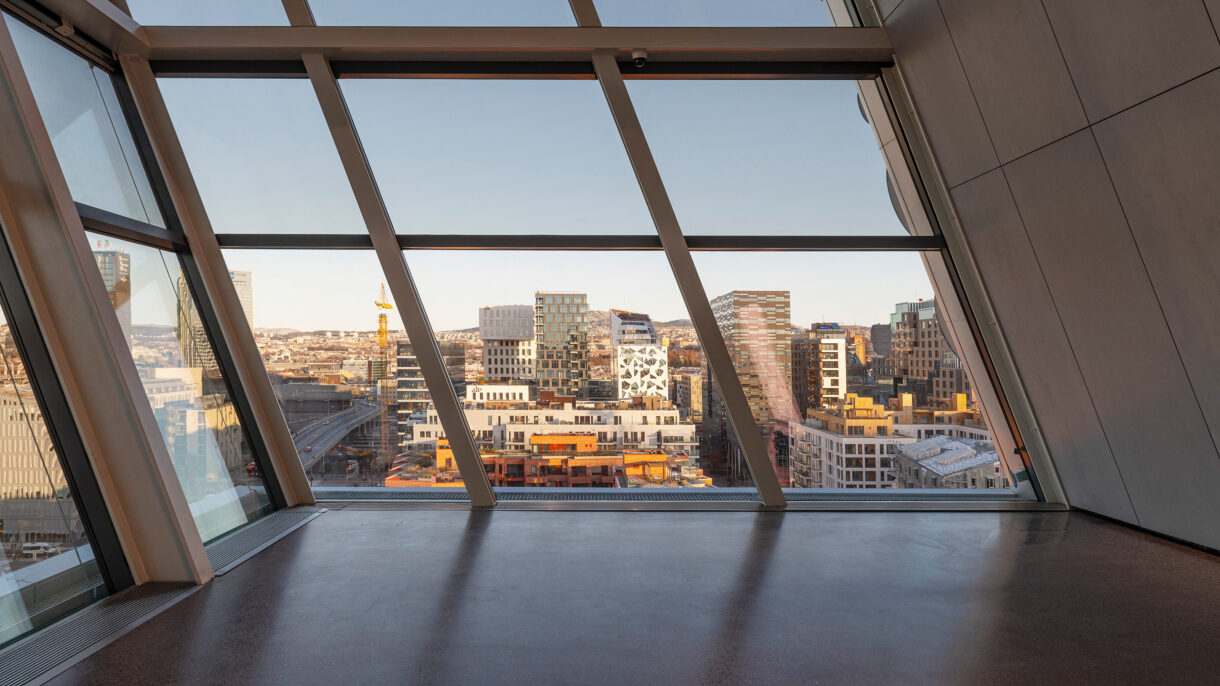
The tower, which sits on a three-storey podium, has two zones: one static and one dynamic. The static zone is an enclosed concrete structure, which complies with stringent security, humidity and daylight requirements in order to protect the art within. The dynamic zone, which has an open, transparent façade with views over the city, is where visitors can move between the different exhibition areas. The city outside can be glimpsed through the glass façade and the perforated wavy panels, which makes the transition from one floor to another a part of the museum experience. The façade reflects water, light and the sky in different ways throughout the day and during the various seasons.
The podium primarily houses external public functions such as the main entrance, foyer area, museum shop, cloakrooms and a café. There is also a small amphitheatre surrounded by glass wall for having seminars and showing films. The upper part of the podium also contains a hall for diverse events. The hall is suspended from the ceiling of the podium without any support from columns below.The two upper floors will house a restaurant, bar and roof terrace –and the view over the city and fjord is stunning!
Environmental ambitions
From the beginning the City of Oslo set ambitious environmental goals for the project with the requirement that the building should be at the forefront in terms of both energy savings and reduced climate gas emissions. MUNCH has been constructed in accordance with the FutureBuilt criteria of at least 50 percent less climate gas emissions than equivalent buildings. Reductions in climate gas emissions apply to the areas of transport, energy and choice of materials and entail reducing climate gas emissions throughout the building's life cycle–during the planning, construction and operational phase.
The new museum has been built as a passive house, i.e. the energy requirements of the building will be reduced through “passive measures” such as optimal heat insulation, optimally insulated windows and heat recovery.
As a pilot project in the FutureBuilt programme, MUNCH inspires and motivates public and private stakeholders to take environmental and sustainability considerations into account in construction processes from the very start.
Examples of environmental measures:
Façade The external perforated wavy panels provide excellent solar shading. The perforations in the panels vary in size and have been customised to provide the most optimal level of solar shading. For example, to give visitors the best view of the city there are larger perforations in the circulation areas. At the entrances to the various exhibition halls, the perforations are denser in order to prevent light from penetrating and ensure a lower temperature. The excellent solar shading in the panels helps reduce the need for cooling.
The glass used in the façade throughout the front of the building is solar reflective. It is made up of three layers of glass, resulting in minimal heat loss. The window frame system also insulates extremely well, reducing the need for heating and cooling.
The eastern side of the building primarily uses concrete behind the panels. This part of the building intentionally faces east in order to reduce solar heating.
Two climate zones in the tower The most significant device in the building’s energy and environmental concept are the different needs and functions of various parts of the building. It has been important to distinguish between the zone offering visitors access to the exhibits and the parts of the museum dedicated to preserving the artefacts.
The tower has been divided into two climate zones. The main part of the tower is built in concrete and features climate locks at the entrances to the exhibition halls to ensure a stable interior climate for the exhibits. The concrete has thermal properties that make it easier to maintain a stable temperature and a regular interior climate, thereby contributing to a reduction in energy consumption. In order to provide appropriate conditions for the respective artecacs the temperature in the exhibition areas will be 21°C and the air humidity 50 percent.
A greater temperature range is permitted in the circulation areas for visitors and natural ventilation will reduce energy consumption.
Sedumroof The podium will have a green sedum roof that provides optimal stormwater management.
District heating and cooling from seawater The new museum is connected to a district heating plant. The district heating plant was connected during the construction phase in order to use eco-friendly heating as soon as possible. The museum is also connected to a seawater cooling plant.
Low carbon concrete In order to reduce climate gas emissions MUNCH has been built using low carbon concrete. One of the greatest environmental challenges when using concrete is the high level of climate gas emissions generated when cement is made. Low carbon is defined as concrete that has been adapted to limit climate gas emissions – for example through the use of new additives such as fly ash as a replacement for cement or that a high proportion of climate-neutral fuel is used during production in order to reduce CO2 emissions.
Recycled steel in the structure and in reinforcing rods Recycled steel has been used in both the building’s structure and reinforcing rods. The new Munch Museum has been built from robust materials with a long life cycle. The building has been designed with a technical life cycle of 200 years on load bearing and structure.
Energy control system The new museum is equipped with an energy control system that optimises the building’s energy consumption.
Well served by public transport MUNCH is centrally located close to Jernbanetorget and is well served by public transport.
Low carbon strategies
• Location near Norway´s most important public transit hub • An external skin with good insulation, very good windows and low cold-bridging values • High heat recovery and a high use of recycled air • Few windows in the static part of the building (the exhibition areas) • Energy efficiency by allowing a relatively high temperature variation in the dynamic part • Energy efficient lighting system • Low-emitting materials like glass, concrete, wood, stone and tiles
Facts:
Client: The City of Oslo Project management: ÅF Advansia Architects: Estudio Herreros + Norwegian partner: LPO arkitekter AS Interior architect: AS Scenario Interiørarkitekter Consulting engineers: Multiconsult, COWI, Rambøll and Asplan Viak Gross floor area: 26,313 m2 Visitor capacity: 500,000 per annum, 2,000 per day Construction started in 2015 Open to the public in 2021 Environment: Passive house standards and a minimum 50 percent reduction in CO2 emissions relative to equivalent buildings. A pilot project in FutureBuilt.
More information:
Time lapse 1 of the construction of the new Munch Museum
Time lapse 2 of the construction of the new Munch Museum
Key Figures
AREA COVERAGE
24200 m²
| Area BTA | 26313 m2 |
| Area BRA | 23516 m2 |
| Heated area BRA | 22081 m2 |
GREENHOUSE GAS ACCOUNTING
| Reference | Project | Done | Operates | |
| Energy | 14,5 | 5,6 | — | — |
| material Use | 18,7 | 9,2 | — | — |
| Transportation | 15,8 | 4 | — | — |
ENERGY
Net energy consumption: 71,6 kWh/m². Delivered energy: 73,3 kWh/m²
Project Information
PROJECT DETAILS
| Address: | Edvard Munchs plass 1, Oslo |
| Municipality: | Oslo |
| Project period: | 2008 - 2021 |
| Status: | Completed |
| Project type: | New building / addition |
| Function / Building type: | Cultural building / facility |
| Exemplar Program: | FutureBuilt |
PROJECT TEAM
| Client: | Oslo kommune, Kultur- og idrettsbygg |
| Architect: | estudio Herreros (local architect: LPO arkitekter) |
| Project Management: | ÅF Advansia AS |