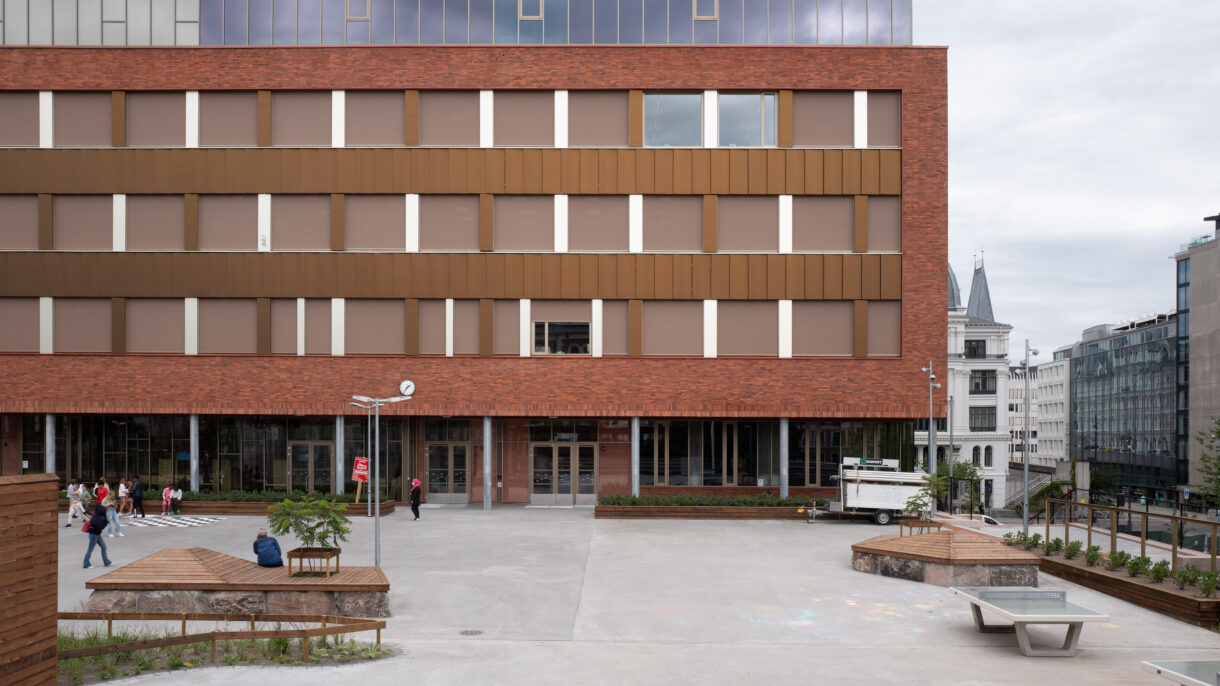
_1.jpg "Nye Ruseløkka skole | Arkitekt: Gasa | Fotograf: Oslobygg KF/Ståle Felberg")

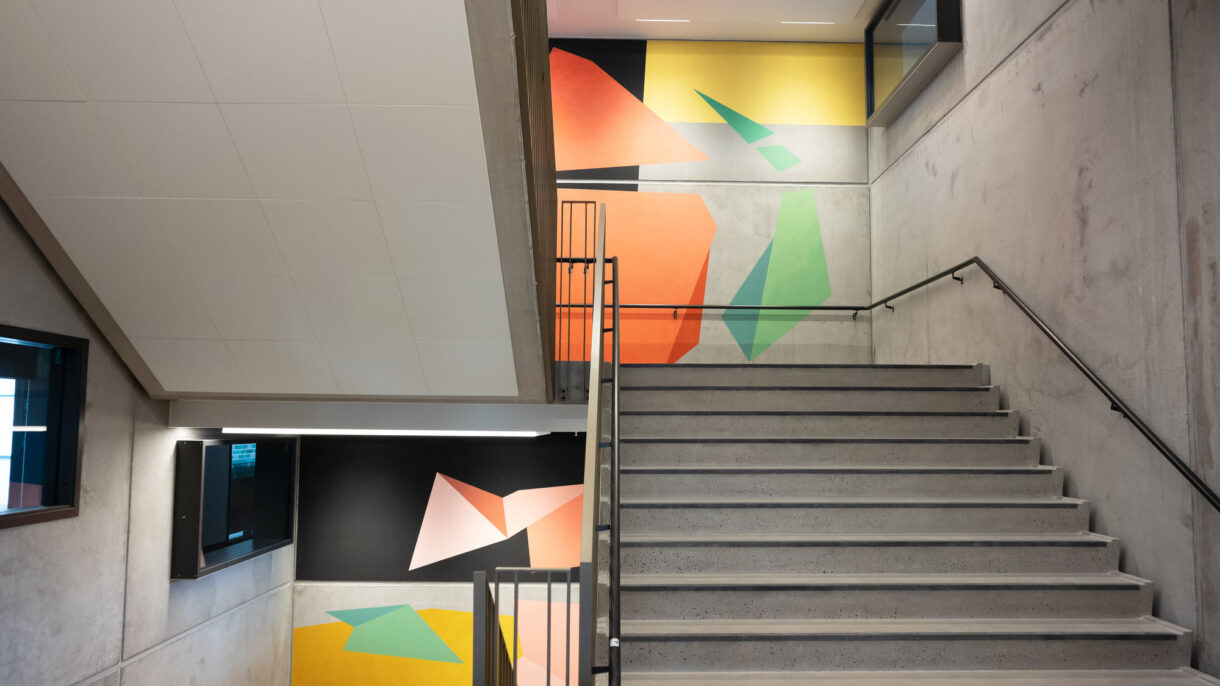
.jpg "Interiør | Arkitekt: Arkitektkontoret GASA AS | Fotograf: Espen Dahl / Arkitektkontoret GASA AS")
Ruseløkka School, Oslo
2022.11.29 15:18
Reuse of building materials and design for future reuse. Integrated photovoltaics in the building façade and on the green roof. The new Ruseløkka school is a near net zero energy school.
Developer
Undervisningsbygg Oslo
Municipality
Oslo
Architect
Arkitektkontoret Gasa
Environmental Consultant
Asplan Viak
Landscape Architect
Asplan Viak
Status
Completed (2022)
Project description
The New Ruseløkka school consists of a new primary and lower secondary school for 690 pupils. The existing school building was demolished and new Ruseløkka school was built on the same site. The school has set high energy ambitions and aims to be a near net zero energy building. The school also offers several special classrooms such as a large dance studio and a multi-purpose room for cultural activities both in and after school hours.
Ruseløkka school is a pilot project for the use of 2nd generation concrete and for circular meassures. As part of the project, materials from the original building have been reused in the new school building. 4,500 bricks, wooden beams and granite blocks from the interior staircase was stored for reuse. In order to simplify future reuse of the old bricks, lime mortar has been used in interior brickwork.
The building site at Ruseløkka was fossil free, including the transportation of surplus landfill.
Process
Ruseløkka school is built as a design and build contract where the environmental strategies and qualities were described in the tender documents. Ruseløkka school became a FutureBuilt pilot after the contract was signed, and FutureBuilt has been involved in challenging the project further with respect to environmental strategies.
Economy
The project has received national Klimasats (climate adaption) funding for the increased costs connected with the use of 2nd generation concrete.
Environmental Strategies
City environment and architecture
The new school building is placed as a free-standing volume towards Løkkevegen. The building continues and consolidates the façade lines in the area and the height of the building fits with its surroundings.
The new school has a smaller footprint than the old school, and this granted a larger outdoor area. The school building is given a high architectural quality with long durability and good detailing. The outdoor area has excellent sun condtions and is accessible for neighbors after school hours. The position of the new building will give maximum shielding from traffic noise.
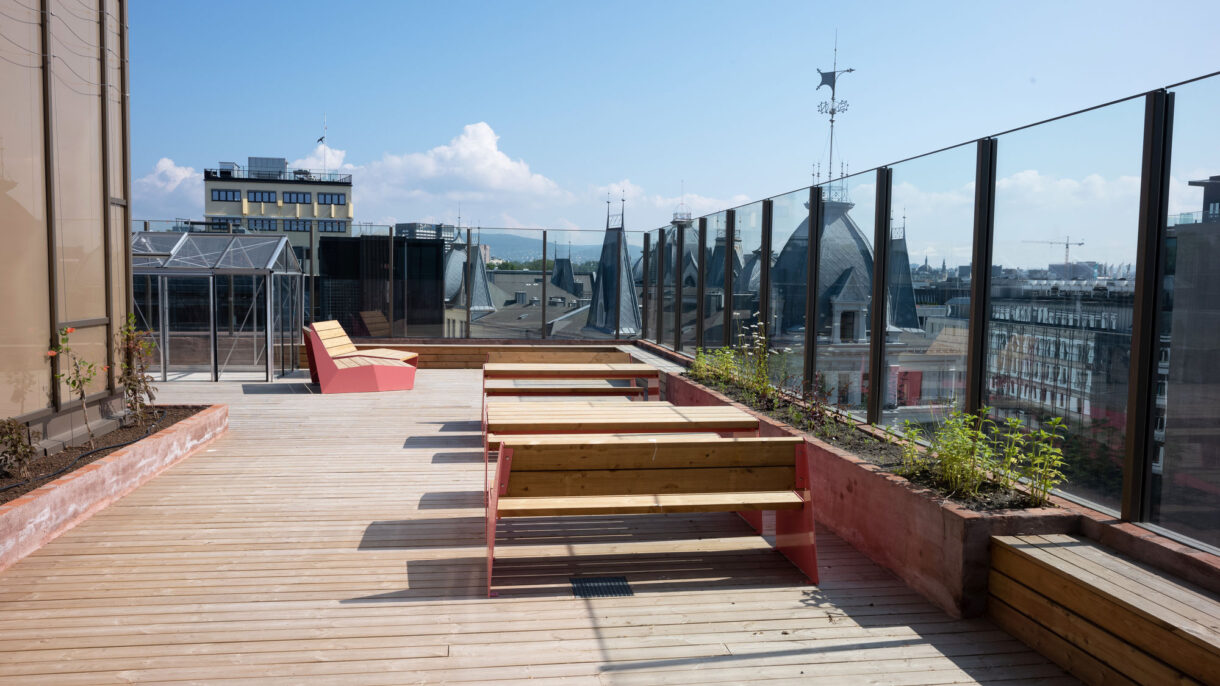
Sunken games area (20cm deep), planted areas and a green roof on part of the building enable open, natural surface water management. Existing trees are kept as far as possible and will along with newly planted areas contribute both visually as well as surface water infiltration. The terrain is shaped to lead the water away from the school façade and towards the planted area and the playground.
Transport
Ruseløkka school is situated close to public transport. Tram line 12 stops by the school, and the school is located only 450 metres from Nationaltheatret station with train, metro and tram connection. Several bus lines pass close by, and ferry lines are also easily accessible from Aker brygge. Therefore, there are no plans for car parking except for disabled users. There are, however, 155 parking places for bicycles. The project Is planned according to FutureBuilt’s consultant for bicycle friendly buildings. A travel habits survey will be carried out after the school opens.
Energy
Undervisningsbygg gained useful knowledge from Brynseng school with respect to energy production, fixing of the solar panels, purchasing and regulations. To achieve the energy targets (near net zero energy ), 320m2 of integrated photovoltaics have been mounted in the façade. 370m2 of photovoltaics are also placed on a green roof to investigate whether this combination can contribute to a more efficient energy production.
The project also tests photovoltaics in the asphalt as a new innovative method to organize energy production. The building is situated within the zoning area for district heating and will use this heat source for space heating, hot water and air ventilation. Secondly, PV panels will contribute to a reduced need to purchase electricity. The PV panels in the façade and on the roof are estimated to produce approximately 75,000kWh/year.
The energy consumption is reduced by building according to passive house codes. The school aims to achieve energy certification dark green A. Simulation of the interior climate shows that in certain conditions there will be a need for cooling. Since the need for cooling is small, the project has received approval to test out adiabatic cooling, which is a very energy efficient method of cooling the building using vapour.
Materials
The building is constructed in steel and concrete, with a requirement for low carbon concrete and recycled steel. The project serves as a pilot project through the use of 2nd generation low carbon concrete. Materials and building components from the existing building were stored for reuse in the new building. Some 4,500 bricks were mined from the old school building and are used as interior walls in the main entrance hall. Granite steps from the old staircase are upcycled as benches outside. The old doors were disassembled and stored for reuse in other projects. The aim has been to gain experience with material recycling and reuse which can be applied in other projects.
Other Environmental Strategies
Ruseløkka has been a fossil fuel free building site both during demolition and construction. This also includes the transportation of surplus landfill. District heating have been used for heating and drying the building and the project have had several electrically powered construction vehicles, such as dump trucks, wheel loaders and forklifts.
Key Figures
| Area BTA | 10286 m2 |
| Area BRA | 9815 m2 |
| Heated area BRA | 41448 m2 |
ENERGY
| Energy label: | A |
| Heating Rank: | green |
| Net energy: | 57 kWh/m2/year (NS3031) |
| 69 kWh/m2/year Passive House standard |
ENERGY BUDGET
| Space heating: | 7,4 kWh/m2/year |
| Plumbing: | 5,3 kWh/m2/year |
| Hot water: | 10,1 kWh/m2/year |
| Fan operation: | 8,6 kWh/m2/year |
| Pump operation: | 1,8 kWh/m2/year |
| Lighting: | 9,9 kWh/m2/year |
| Technical equipment: | 8,8 kWh/m2/year |
| Other energy items: | 5 kWh/m2/year |
BUILDING TECHNICAL
| U-value roof: | 0,11 average value |
| U-value floor: | 0,09 average value |
| U-value exterior wall: | 0,15 average value |
| U-value window/doors: | 0,7 average value |
TRANSPORTATION
| Distance to center: | 50 m |
| Nearest welding mac. koll.knutepkt: | 450 m |
| Parking: | 0,1 (Pr. 1000 m2) |
| Bicycle Parking: | 15,1 (Per 1000 m2) |
Project Information
PROJECT DETAILS
| Address: | Cort Adelers gate 30, Oslo |
| Municipality: | Oslo |
| Project period: | 2016 - 2021 |
| Status: | Completed (2021) |
| Project type: | New building / addition |
| Function / Building type: | School / educational facility |
| Environmental standard: | Passive house standard |
| Exemplar Program: | FutureBuilt |
| Competition Form: | Framework agreement |
| Contract practice: | Design and build contract |
PROJECT TEAM
| Client: | Undervisningsbygg Oslo KF |
| Architect: | Gasa A/S, Arkitektkontoret, Asplan Viak AS |
| Project Management: | Undervisningsbygg Oslo KF, Veidekke AS |
| Environmental Consultant: | Asplan Viak |
| Counselors: | Bjørnstad Prosjektering AS, Union Consult AS, SIVILINGENIØR SV BOLKESJØ ANS, Roar Jørgensen AS, Multiconsult AS |
| Main contractor: | Veidekke ASA |