.jpg "Rainbed | Arkitekt: Bjørbekk & Lindheim | Fotograf: Bjørbekk & Lindheim")
.jpg "The building includes several amenities available to the public | Arkitekt: Hille Melbye Arkitekter og Kristin Jarmund Arkitekter (ark) + Bjørbekk & Lindheim (lark) | Fotograf: Oslo Havn")
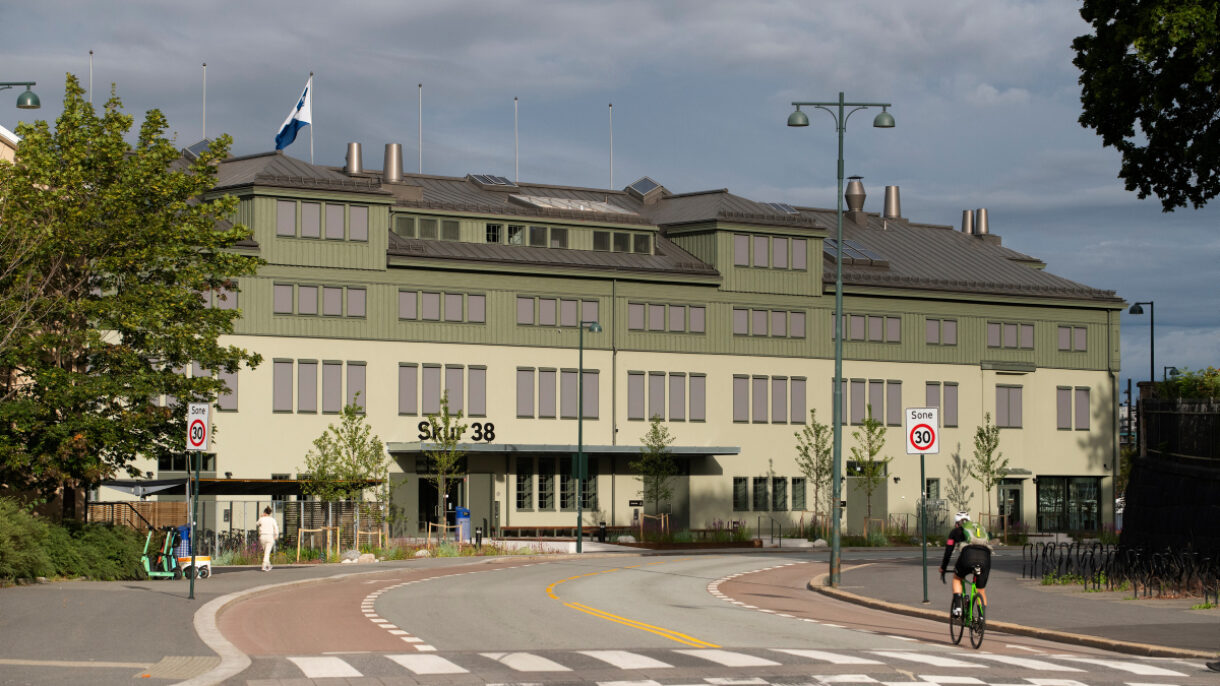
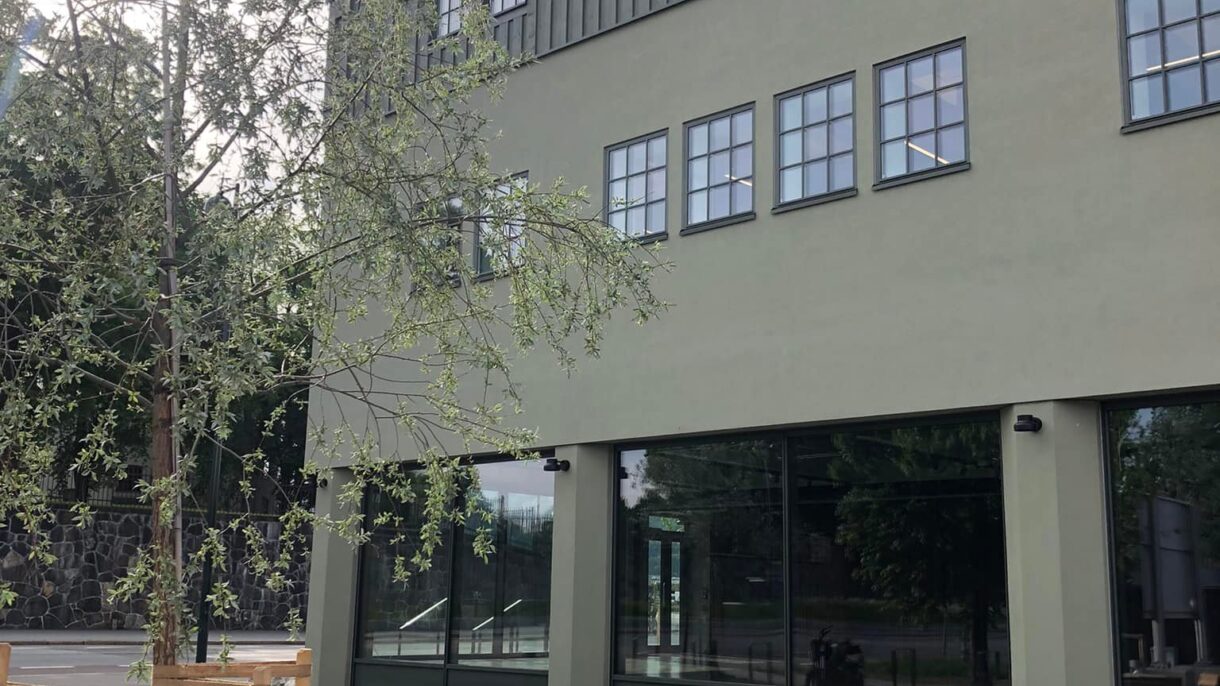
.jpg "The renovation plays up the building’s history, even as it employs cutting-edge technology and energy-efficient solutions | Arkitekt: Hille Melbye Arkitekter AS, Kristin Jarmund Arkitekter AS | Fotograf: Hans Kristian Riise/Oslo Havn")
Skur 38, Oslo
2023.01.17 08:21
The Oslo Port Authority has renovated the yellow-listed Skur 38 (“Shed 38”) in accordance with circular principles. The renovation plays up the building’s history, even as it employs cutting-edge technology and energy-efficient solutions.
Developer
Oslo Havn
Municipality
Oslo
Architect
Hille Melbye Arkitekter, Kristin Jarmund Arkitekter
Environmental Consultant / Landscape Architect
Bollinger + Grohmann Ingeniører / zero emission studio
Landscape Architect
Bjørbekk & Lindheim
Status
Completed (2022)
Project description
Originally built as a warehouse in 1915, Skur 38 was remodelled to serve as the Oslo Port Authority’s headquarters in 1987. It had not been upgraded since and was severely in need of renovation and modernization. Renovation work began in autumn 2020, and finished in summer of 2022.
Circular solutions
Oslo’s Cultural Heritage Management Office has yellow-listed Skur 38, but that has not curtailed the project’s environmental ambitions, quite the contrary. The building is renovated according to circular principles, with Oslo Port Authority cataloguing exactly which parts of the building can be reused by this or other projects. When feasible, existing structures has been retained and upgraded to prolong their lifetime, according to FutureBuilt’s criteria for circular buildings.
In order to promote the building’s original history as a warehouse, the current façades and interiors are adjusted. The annex from 1950, built to service boats from the Amerikalinjen shipping company, featured an open loggia supported by sturdy, octagonal pillars, and a withdrawn glass façade is therefore installed here to highlight the massive columns. The façade’s original loading doors are also made more pronounced.
Clay-based concrete
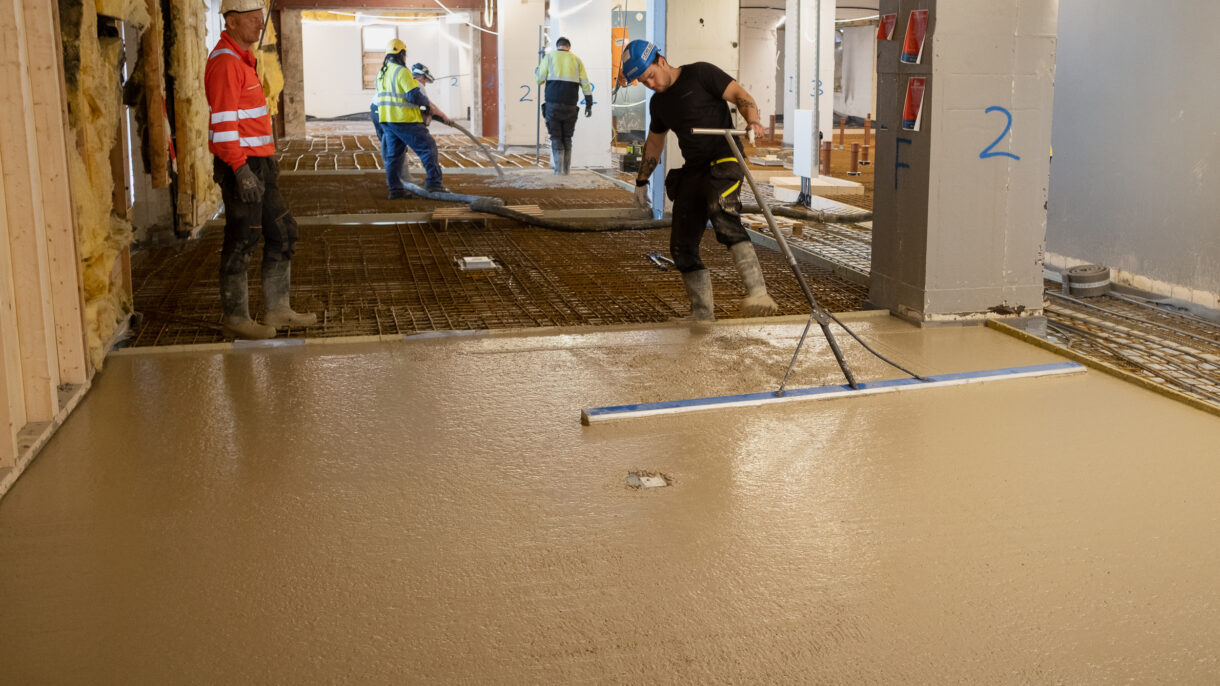
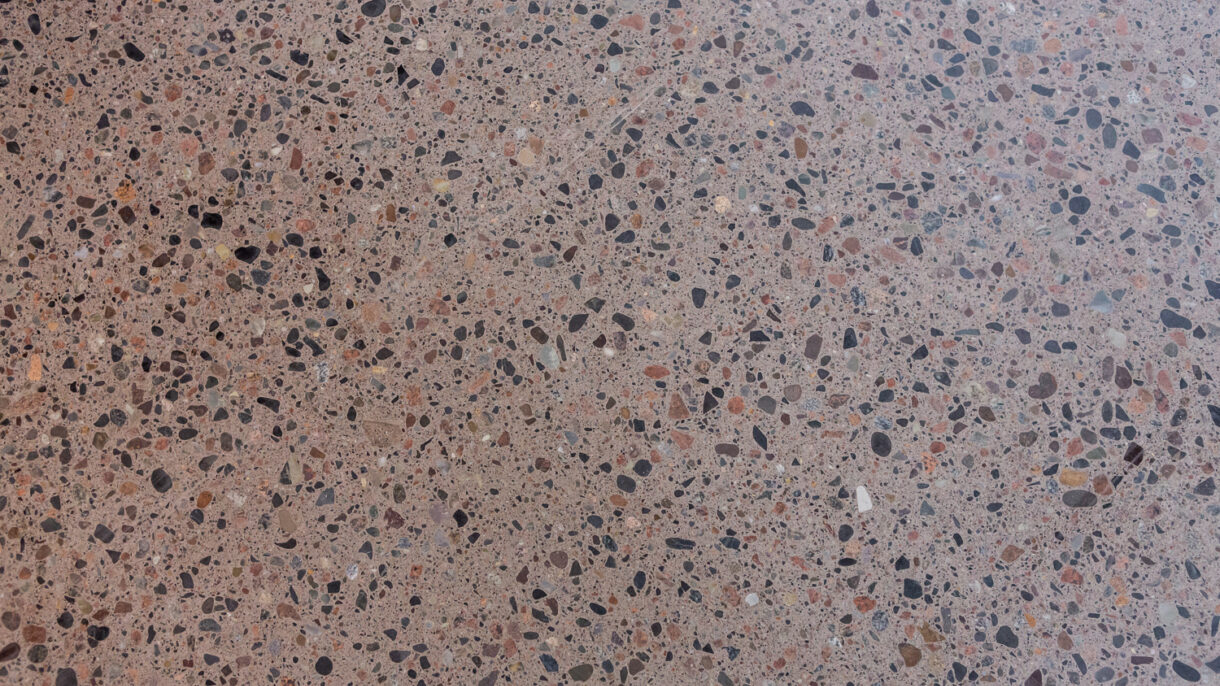
Skur 38 is also the first project in Norway to use clay-based concrete, and 65 cubic metres of Futurecem from Unicon has been used to cast a new foundation floor. Futurecem is a type of concrete where over 40 per cent of the clinker has been replaced by calcinated (burnt) clay and limestone powder. In addition to being widely available, clay has two major advantages: it is fired at a much lower temperature than cement, something that in itself reduces the project’s carbon footprint, and it can be calcinated with biofuel, unlike cement. Clay thus helps reduce CO2 emissions substantially.
Extra insulation
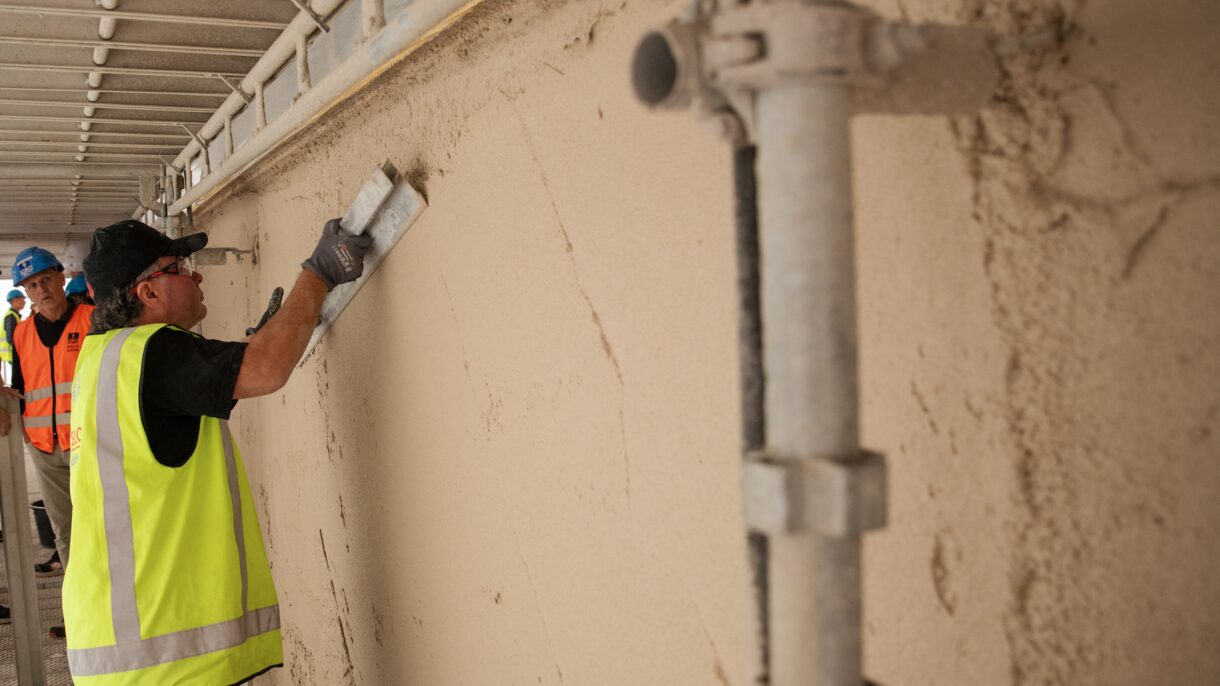
The project used insulation plaster with aerogel in order to achieve the low U-values needed to be certified as Excellent by BREEAM Excellent, even while preserving the characteristic look of the stucco façades. The robust Isokalk mortar works well as insulation has previously been used on listed buildings with good success. Because of its high insulation value, Isokalk does not need to be applied thickly and will therefore not conspicuously alter a façade’s appearance – a key consideration when renovating Skur 38.
Energy
Solar panels on the roof were considered, but ultimately rejected. In addition to preservation concerns, it turned out that the cost-benefit effect was low because of the shape of the roof, whose shadow will inevitably impact the panels and make them less effective.
Energy is supplied by a local air-to-water heat pump. In the long run, the system will be able to link up to a common heating central based on seawater heat or district heating – solutions that are too expensive to implement solely for Skur 38. However, such a joint solution for the entire Akershusstranda harbourfront is feasible within a time frame of 10–15 years.The project aims to be an emission-free construction site as far as possible, and will otherwise be fossil-free in order to reduce CO2 emissions from the construction phase.
Open to the public
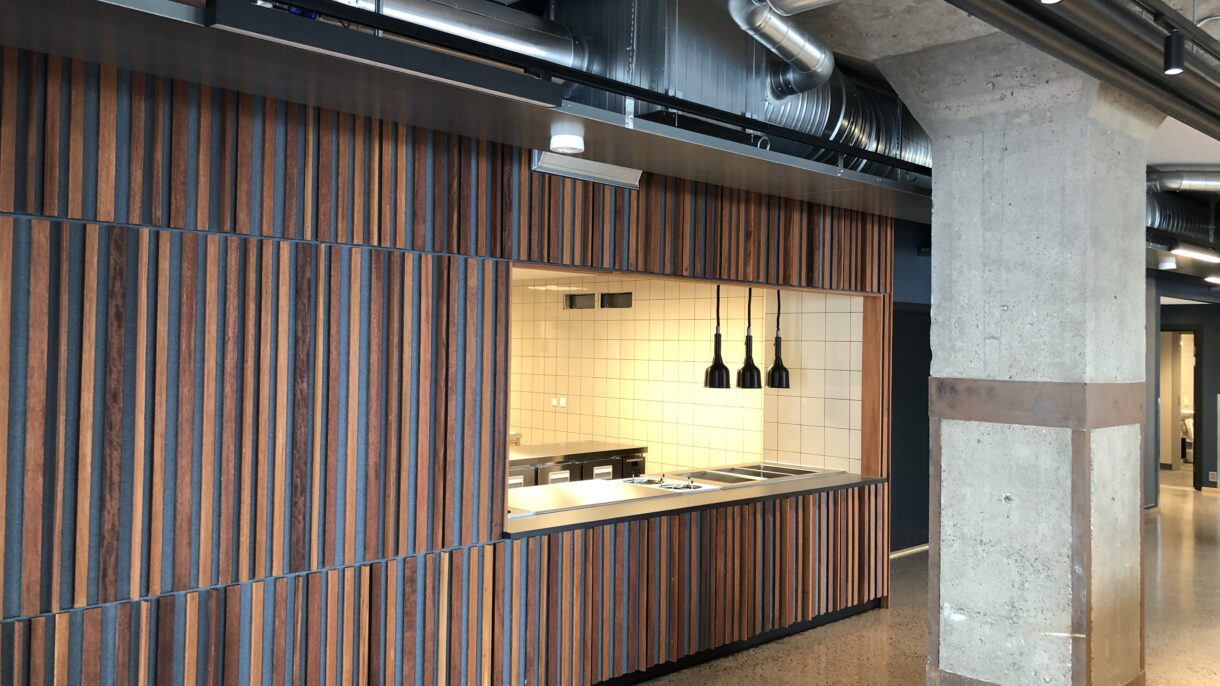
The building includes several amenities available to the public on level 1. A visitor centre presents the port authority’s responsibilities and goals, especially in regard to sustainability. The project includes a conference centre with a separate entrance, large meeting rooms and a seminar room. Skur 38’s neighbours will be able to rent these facilities. The lunchroom is open to neighbouring enterprises, and space has also been set aside for outside parties who want to run a café.
Transport
Pedestrians and cyclists are given priority in and around the building
High-quality indoor and outdoor cycling facilities are available, including changing rooms and service areas for washing and repairing bikes
All forms of Oslo’s public transport are available nearby
All of the port authority’s own cars will be electric, and additional charging stations will be facilitated
A pool of e bikes and e scooters can be used by employees when travelling on official business
Journeys by car to and from the building shall be cut to a minimum
The number of parking spaces for cars is reduced from 31 to 7, of which five will be reserved for cars in official use.
Biodiversity
Earlier, the outdoor area at Skur 38 was paved surface without vegetation. The potential to improve the area’s biodiversity was therefore large. By attaching itself to the neighbourhood’s existing green space, the project helps establish a continual green space along the harbour promenade. Additional green and permeable surfaces also improves the stormwater management.
An illumination strategy was implemented to prevent local lighting pollution. This was also in effect during the construction phase: Lights were turned off when there was no activity at the construction site, and lighting that was deemed necessary to prevent accidents or theft was driven by sensors.
Key Figures
| Area BTA | 3333 m2 |
| Area BRA | 3772 m2 |
| Number of residents / users | 155 |
| glass Share | 0,19 % |
| Compact clergy Factor | 0,2878 m3 volume/m2 |
GREENHOUSE GAS ACCOUNTING
| Reference | Project | Done | Operates | |
| Energy | 14,4 | 13,4 | — | — |
| material Use | 6,8 | 4,8 | — | — |
| Transportation | 3,4 | 3,4 | — | — |
ENERGY
Netto energibehov:108 kWh/m2 åe. Levert energi: 173 kWh/m2 år (beregnet i hht NS 3700/3701).
| Net energy: | 108 kWh/m2/year (NS3031) |
| 108 kWh/m2/year Passive House standard | |
| Supplied energy is calculated: | 173 kWh/m2/year (NS3031) |
| 173 kWh/m2/year Passive House standard | |
| Energy Sources: | Varmepumpe luft-vann (det tilrettelegges for felles sjøvanns varmepumpe), Elektrokjel for vannbåren varme (kun spisslast) |
ENERGY BUDGET
| Space heating: | 5 kWh/m2/year |
| Plumbing: | 5,3 kWh/m2/year |
| Hot water: | 10 kWh/m2/year |
| Fan operation: | 17,4 kWh/m2/year |
| Pump operation: | 1,9 kWh/m2/year |
| Lighting: | 43,8 kWh/m2/year |
| Technical equipment: | 63,2 kWh/m2/year |
| Ventilation Cooling: | 11,4 kWh/m2/year |
BUILDING TECHNICAL
| U-value roof: | 0,13 average value |
| U-value floor: | 0,09 average value |
| U-value exterior wall: | 0,14 average value |
| U-value window/doors: | 0,77 average value |
| Tightness Testing (measured) | 0,5 (At 50 Pa pressure) |
| SFP factor ventilation: | 1,5 kW/(m3/s) |
TRANSPORTATION
| Distance to center: | 1000 m |
| Nearest welding mac. koll.knutepkt: | 200 m |
| Parking: | 2,1 (Pr. 1000 m2) |
| Bicycle Parking: | 21,3 (Per 1000 m2) |
| 0,5 (Pr. Unit/arb.plass) |
COSTS AND SUPPORT
| Project support Enova: | 3850000 kr |
Project Information
PROJECT DETAILS
| Address: | Akershusstranda 19 |
| Municipality: | Oslo |
| Project period: | 2019 - 2022 |
| Project type: | Reuse / rehabilitation / transformation |
| Function / Building type: | Office building |
| Environmental standard: | BREEAM Excellent |
| Exemplar Program: | FutureBuilt |
| Contract practice: | Design and build contract |
PROJECT TEAM
| Client: | Oslo Havn |
| Architect: | Hille Melbye Arkitekter AS, Kristin Jarmund Arkitekter AS |
| Originally architect: | Bernt Arlet Christian Lange |
| Landscape Architect: | Bjørbekk & Lindheim Landskapsarkitekter AS |
| Interior Architect: | IARK |
| Project Management: | ÅF Advansia AS |
| Environmental Consultant: | Bollinger + Grohmann Ingeniører AS |
| Counselors: | Protekno AS, Protekno AS, PEP AS, KB arkitekter AS, Focus AS, Brekke & Strand Akustikk AS |
| Main contractor: | Varden Entreprenør AS |
| Construction Management: | Varden Entreprenør AS |