Tallhall, Meterological Institute, Oslo
2023.01.07 10:34
Tallhall is the Meterological Institute´s newest building in Oslo. It is a climate friendly building with good detailing and innovative material use.
Developer
Meteorologisk institutt
Municipality
Oslo
Architect
Pir II Oslo
Landscape Architect
Arkitekturverkstedet i Oslo/Asplan viak
Cost and support
Building costs approx. 42 000 kr/m2. Project support Enova: approx. 1,5 MNOK.
Status
Completed (2011)
Project description
The Meterological Institute is Norway´s most important supplier of information, news and research about climate and meteorology, and therefore aspired to create a low carbon building. Construction of Tallhall began in the autumn of 2009 and it was officially opened in June 2011.
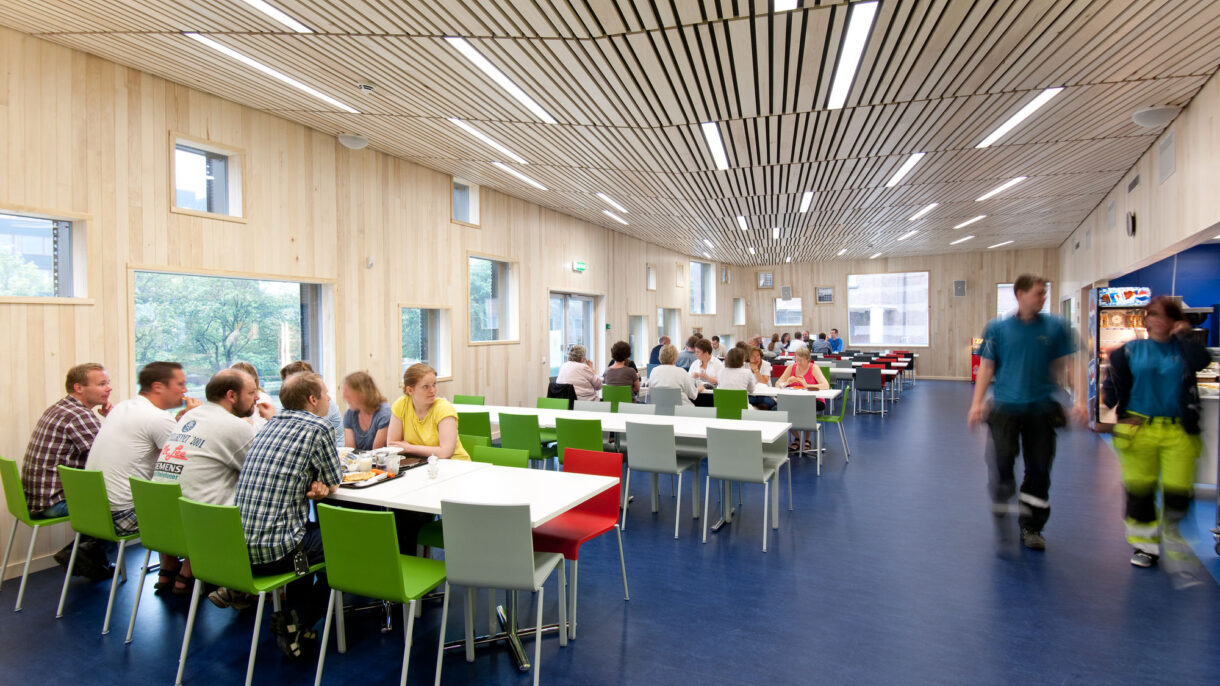
The Meterological Institute´s new building at Blindern in Oslo is a two-floor addition to the institute´s existing offices. The name Tallhall (“Numbers hall”) comes from the fact that the new building houses a data centre in the ground floor. The canteen and meeting rooms are located on the first floor.
The building´s dual function has heavily influenced the architecture. On one side the building is designed to house extremely technical areas, with requirements for airtightness, security and very limited access. In contrast, the meeting and eating spaces are open and welcoming.
The conflicting demands dictated the organisation of the building, with the technical areas lying on the lowest floor and the public and employee facilities located above. The sloping terrain facilitates this natural division, giving direct and universal access to the appropriate floors on both sides.
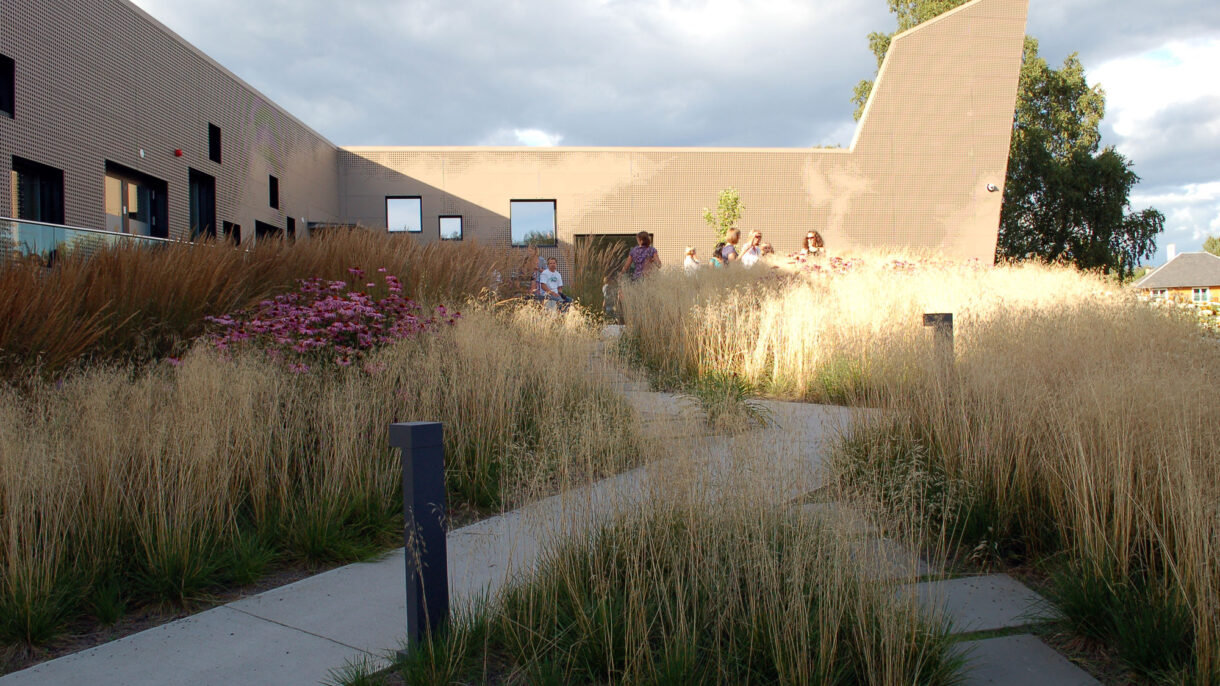
In terms of form, the same dual-purpose is clearly expressed. The building is compact and rational for the introverted functions and more expressive for the extroverted functions. The outermost area, where the meeting rooms are located, stretches up to become a two-storey space. This becomes a significant element that defines the outside space beside the public entrances, while forming a protective wall against the wind and noise from the technical installations.
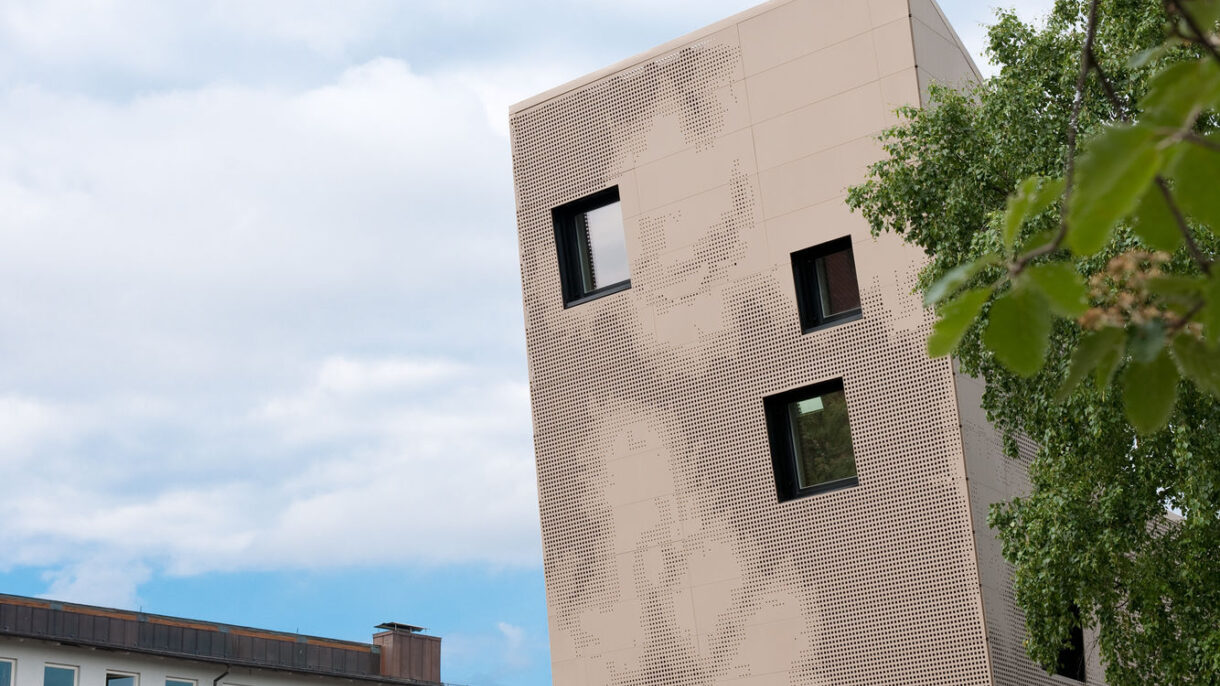
The perforated aluminium cladding describes the functions within the building by changing from ‘opaque and secure’ to ‘perforated and secure’ as necessary. This includes where the cladding is used as a visual and security screen around the rooftop cooling machines. The cladding forms a cloud pattern, which represents the institutes core activity and role.
Low carbon strategies
The extension was built over an area previously used for parking, which reduced the number of parking places by 36 per cent. The institute offers its employees a covered and secure cycle area (with 40 places). Other mobility initiatives are video conferencing, home office solutions and a cycle to work program.
During the design of Tallhall the greenhouse gas emission calculations were carried out as an ongoing part of the design process. The focus has been on energy consumption and material use. Transport is not included in the calculations because the building only provides new service functions and does not involve any new employees.
The building is designed with an emphasis on passive energy design and the first floor meets passive house standard in the category “University and high school building”. The new data centre on the ground floor requires a lot of cooling. The excess heat that the cooling system produces is recovered with a heat pump, and reused as heat for ventilation air and room heating. Other energy strategies include daylight control, automation and demand management of the technical systems, as well as low-energy office equipment.
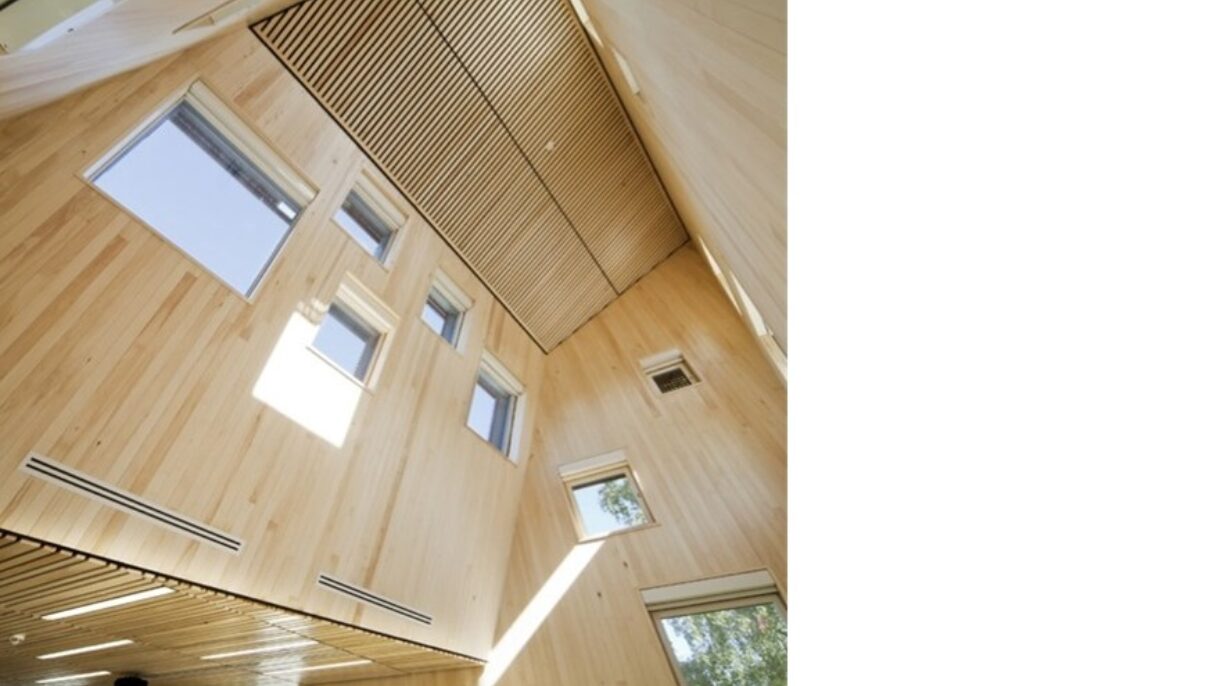
Materials were carefully selected for their environmental properties. The ground floor is constructed in low-carbon concrete with an increased proportion of fly ash. The first floor is built as infill timber studwork around a load-bearing steel frame, and internal cladding and ceilings are solid wood and wood fibreboard. The solid and perforated external cladding sheets are made with 100 per cent recycled aluminium. These choices result in a reduction in greenhouse gas emissions from material use of 40–45 per cent.
Economy
Project support Enova: approx. 1,5 MNOK.
Key Figures
AREA COVERAGE
1471 m² (Net heated area), data centre on ground floor: 975 m², canteen and meeting rooms on 1st floor: 496 m²
| Heated area BRA | 1471 m² |
GREENHOUSE GAS ACCOUNTING
| Reference | Project | Done | Operates | |
| Energy | 36 | 20 | 18 | 28 |
| Material use | 21 | 14 | 10 | 10 |
ENERGY
Net energy consumption: 132 kWh/m² year Delivered energy: 123 kWh/m² year (Calculated according to NS3031 with standard climate). Average value for data centre, canteen and meeting room areas.
| Energy label: | A |
| Heating rank: | green |
| Net energy: | 132 kWh/m²/year (NS3031) |
| Supplied energy is calculated: | 123 kWh/m²/year (NS3031) |
| Energy sources: | Waste heat from data centre, local heat pump, district heating system and electricity. 1st floor: Electricity (99%). 2nd floor: Direct electricity (83%), electricity for heat pump (6%), district heating (11%). |
BUILDING TECHNICAL
| Tightness Testing (measured) | 0,47 (At 50 Pa pressure) |
COSTS AND SUPPORT
Building costs approx. 42 000 kr/m². Extra costs for passive house standard: 6,9%. Project support Enova: approx. 1,5 MNOK.
Project Information
PROJECT DETAILS
| Address: | Henrik Mohns plass 1, 0313 Oslo Blindern |
| Municipality: | Oslo |
| Project period: | 2008 - 2011 |
| Status: | Completed (2011) |
| Project type: | New building/addition |
| Function/building type: | Office building, university/college building |
| Environmental standard: | Passive house standard |
| Exemplar program: | FutureBuilt |
PROJECT TEAM
| Client: | Meteorologisk institutt |
| Architect: | Pir II Oslo AS, Arkitekturverkstedet i Oslo/Asplan viak |
| Project management (PM) | Sohlberg og Toftenes AS |
| Special adviser energy: | SINTEF Byggforsk, Esbensen Rådgivende Ingeniører AS |
| Counselors: | Dr. techn. Kristoffer Apeland AS, Aalerud AS Rådgivede ingeniører, IBR el-prosjekt AS, Neas Consulting, Brekke & Strand Akustikk AS |
| Main contractor: | Eide entreprenør AS (Årnes) |